Friday, June 17, 2011

Day Ten: Home At Last!!!

Today was our final travel day, which was sad.  I woke up with a fever and a sore throat, accompanied by a headache.  Fun.  So I just took Tylenol and then I was peachy.  Our flights were waaay too long, but it was all worth it.  Wake up call was at three this morning, which majorly sucked.  We flew from Cairns to Sydney to L.A. to Chicago, plus a fifteen hour time difference.  All of this put together makes thirty four hours that I was awake until I crash tonight at ten.  How exhausting.  Coming home feels sooo good because I don't have to pay for food, I don't have to wait for a teacher to check my room, I don't have to put up with roommates, even though mine were fantastic, and I can shower whenever I want!!!!!!!  Also, I can do laundry whenever and I have access to a dryer!!! For free!!!  Being home is so nice, as much as I will miss Australia and New Zealand.  I love my house and my room and having a fully stocked fridge and no annoying wake up calls.  And I didn't pass out on the flight home!!!  WHOOOO!!!!!!!


I hope to return to Australia and New Zealand very soon, because they're so amazing and they stole my heart.  I still can't believe I've been there; it hasn't sunk in yet.

Wednesday, June 15, 2011

Day Eight: Great Barrier Reef!!!!!!!

Today, we went to the Great Barrier Reef, which is one of the Seven Wonders of the World; I can clearly see why it's on that list. The GBR is the most unique and most beautiful thing I have ever seen!  We went out in a huge cadamaran and it docked at a permanent pontoon where all the snorkel equipment was.  We went snorkeling as soon as we could, in our uber sexy masks, flippers, and life vests.  We ditched the life vests pretty soon.  The coral was amaxing.  A lot of it was gray, which was sad, but it was all different colors in other places.  And the fish!  Oh, the fish.  They were so cool.  It was Finding Nemo all over again, minus the sharks and jellies.  I'm not kidding, I saw Dory and Nemo and some anemone.  Lexa, Reilly, and I all saw an eel, which was pretty awesome because on one else saw it.  The water was really cold at first, but once we got used to it, it was absolutely amazing and we didn't want to leave.  Kelsy showed Lexa and I a place where the coral was really bright, so we swam around there for a while, and then we brought Amanda and Alex there.  As we cruised aweay from the Reef, I decided that I was going to visit the Reef again, after I saw all of the other Wonders of the World.
The wildlife int he GBR was so incredible becuase it was nothing I had ever seen before.  Aquariums don't do the ocean any justice; it's just so much better when there's no glass or noises, just your breathing through the snorkel.  There were some enormous clams down there.  I didn't realize what they were at first because they were purple on the inside.  And then I saw one close.  I'm not going to lie, it was pretty scary.  Apparently, Mr. Schagrin and Mr. Ewen saw a five foot reef shark and they were chasing it, and, according to Schags, that was when he lost his wedding ring.  I'm pretty jealous of the whole shark thing, but at the same time, they didn't see an awesome eel slithering along the ocean floor.  The GBR amazed me because it is not man made at all, so the fact that it's all natural is incredible.  I've never been much one for nature, but the GBR turned something on inside me that ust makes me want to go explore the whole world and to see all the different ecosystems that can create a little world in which everything can coexist.

Monday, June 13, 2011

Day Six: Sydney Bridge!!!!!!

Today, we split up so some people hiked the Blue Mountains while some of us went whale watching and climbing the Sydney Bridge.  Well, whale watching was cancelled due to poor weather, which sucked, but we were still climbing the bridge.  So in the morning, we went to Paddy's Market, which I did not like, probably due to the fact that I was dizzy the whole time...thanks to the Dramamine I took.  But the Bridge was incredibly cool...we were able to see for sixty miles!!!!!!!  It was unbelievably beautiful.  It was basically a bird's eye view of the entire city.  And then we went back to Alice's for more thai! :)


Over the last week or so, I have thought about how well I would do if I were to travel alone, and I have come to the consensus that I would be a pro in the airport, but getting out into the city or wherever I'm headed might be a little tough for me.  I know airports really well; I've been in way too many to count, but I do know that I've been in at least seventeen.  So airports are kind of my thing.  Getting into the city would be gough, but I could do it.  As long as I book a hotel in advance, I'll be okay for that.  From there on out, I would probably be just fine, as long as I book my outings and plan in advance because if I have a somewhat structured plan, I can leave room for the best part of travel: adventure.  Although I'm not good with navigating at all (I suck at reading maps), I think that I could find my way around, even if it meant getting lost a few times.  I would need some help, probably, just with booking and finding good hotels for cheap rates and looking for flights.
As for the whole adventure part, I would be pretty good because I like to go and explore and (sometimes) get lost because that's fun.  Getting lost is often the best way to find your way around a place.  My biggest challenge while traveling would be a lack of company.  I'm a very talkative perosn, so not having someone by my side to talk to would be really really hard for me.  I suppose I would get used to it, but I feel safer in a group.  Overall, I don't think I could go traveling on my own mainly vecause I'm sixteen years old and even though traveling is second nature by now, it just isn't an easy thing to do, so until I get into college, traveling without people older than me is probalbly a no.

Sunday, June 12, 2011

Day Five: Challenges

Today, we went on a harbour cruise around the Sydney Harbour, which was SO cool because we got to see everything from a different angle than a lot of people do.  My group of friends and I mainly stayed on the top deck so we could have an unobstructed view of everything.  We also explored the city and we got to go inside the Opera House...how cool is that?!  It's pretty cool, but we didn't get to see the concert hall, which is ok...I guess I'll just have to go to a performance there some day.  We also went to the Sydney World Wildlife Center, where we saw koalas!!!!!!!!!!!
Left to right: Me, Lexa, Reilly.  It was pouring.

So far on this amazing, fantastic, crazy, unpredictable trip, the toughes thing has definitely been the lack of a dryer because it is the rainy season.  It has rained nearly everyday this trip, so having dry shoes and pants for the next day has been a little trying on me since that is a luxury at home that I am so used to having.  I am wondering if, at home, I will have to get used to having a dryer again.If I do, I know it won't take long.  Another challenge I have faced is just going with it and not worrying too much.  I have found that as the trip has gone on, I have become more adventurous and much more laid back.  I don't really care if my hair is a little mess up or windblown, which at home, I would probably freak out... My easiest thing to get used to so far is probably bing in such a fun group.  I love traveling with such a great group and surprisingly, dealing with our ups and downs has been one of the best parts of being in a group.  It is also really cool to me to see the different group dynamics as we travel.  For instance, at the Thai restaruant last night, we were a really talkative group, but there have been other groups that barely talk at all like that.
One of my biggest shocks has been how well I'm dealing with all of the fatigue.  I get so soaked up in what we're doing that I forget how tired I am, and I think that's how I know I'm a traveler, not a tourist.  When I signed up for this trip, I knoew I wasn't coming to Australia and New Zealand to relax, I was coming here to become immersed in simething and somewhere new and to forget about Facebook, email, texting, and TV for 11 days.I could honestly live like this forever. I'm having the time of my life.

Saturday, June 11, 2011

Day Four: Sydney!

Today, we flew out of Auckland and into Sydney, Australia!!!  We also walked around and saw the city and explored a little bit, which was really cool because I'm a total city girl.  My camera died, so I'll put up pics from tomorrow or another day.  But when we were walking around Sydney, it got me thinking of Chicago...

Although this is from the harbor cruise on a different day, we saw the Opera House today.


Today, when we left Auckland, I promised myself that I would not allow that to be the only time I traveled to New Zealand; it stole another piece of my heart. <3
However, when we flew over Sydney and I saw the bridge and the Opera House, I knew that I would be returning to Australia as well.  When we were walking around Sydney, it was really odd because I felt like it was a mini city, since it wasn't like the cities in the States, like Chicago.  For one thing, it is shorter, as in the height of the skyscrapers.  I like it because it makes the city more personal and less corporate.  However, I love Chicago as well because it's so iconic and it will always be my home, no matter what.  It reminds me more of London; a smaller city that has tons of culture and tourist attractions, but is also really easy to love and hard to leave.  The fact that the skyscrapers are shorter strikes me as weird just because I am so used to the my beloved Chicago skyline back home, and I couldn't imagine not seeing it from the Metra on the way into Union Station.  My favorite parts of Sydney are cliche, but I don't care.  The Opera House and the Sydney Bridge are really incredible.  The Opera House is way bigger than I ever imagined, and so is the Bride.  I would guess that the Bridge is around the sized of the Golden Gate Bridge in Sand Francisco.  To me, the Opera House is beautiful because of the movement the architecture portrays and how it reflects the movement in the Harbour.  The Rocks Market tonight was really cool; it was really like an art show.  I loved it as well.  Talking to the locals was really fun because they were so different yet so similar.  The people here are sooo fantastic and really are super friendly. 

After that, we had the choice to order pizza in the hotel or go out for dinner, so I decided to go out.  We ended up going to a fantascic place called Alice's Thai Restaurant.  We all tried new food and had a really deep conversation about our trip and traveling in general. (I order chicken pad thai.  It was delicious.)  The group was: Lexa, Megan C., Steven, me, Reilly, Alvaro, and Schags.  I know that when I look back on this trip, I will remember tonight for sure, and that is really important to me bacause I know I have grown from just being in that conversation tonight.  Overall, I love Sydney and I don't want to leave.

Friday, June 10, 2011

Day Three: Hiking and Rangitoto

So today, we went hiking in a Redwood forest here in Rotorua-in the pouring rain.  But it was all cool because we sang Disney songs (and Queen) the whole time and we didn't care what the South Korean tour group thought.  Until they smiled and clapped.  Then we thought we were pretty cool.  Well, after that, naturally, we had to change, so we all returned to the hotel to do so.  Then we bid Rotorua good-bye and we headed to Auckland to visit Rangitoto College.  That was easily the coolest thing ever-a barbecue and another Haka.  Except this Haka was like thirty times better than the pros because because these dancers were high school students.  But more on that later.  
As you may recall, it was raining.

We're just a bunch of tree huggers.  And singers.  What pros.
 This morning, we went for a hike in the Redwood forest, which reminded me of the Redwoods in San Francisco.  Except it wasn't raining when I went to San Fran.  Rain and all, I had a great time; it was quite the adventure.  We traipsed through the trails singing Disney songs, even in front of the South Korean tour group.  Fletch, Lexa, Reilly, Katie, Shelby, Amanda, Madi, and I all sang A Whole New World (Aladdin), The Lion Sleeps Tonight (Lion King), I'll Make a Man Out of You (Mulan), and a ton of others.  We got lots of smiles. :)
This evening, we went and visited our Kiwi buddies at Rangitoto College in Auckland.  It was really cool to meet all of them and to see how different their school was from ours.  For one thing, it's way bigger, with over twice as many students as at North.  They have about 3500, where we have about 1500.  The Rangitoto students seemed a lot like us with all their extracurriculars and sports. However, they are fiercely proud of their Maori culture and background, so they performed an amazing Haka for us, way better than the pros we saw at the Hangi.  The students seemed way more enthusiastic and you could tell they they loved what they were doing one hundred percent,  whereas the pros seemed pretty indifferent as to what they were doing in comparison.  Then they taught us the Haka, which was SO fun, but really hard; I still don't know the words!  The Maori guys looked really scary while they were doing the Haka, and they got all up in each other's faces, which was something the pro Haka group didn't do.  When we were at the Hangi, I didn't understand why anyone would be afraid of someone doing the Hake, but when the high school boys performed it, I totally understood.  Overall, the two Haka groups were really different.
Me and BETH!!!!!!!!!!!!!!!!!!

Awesome Haka!!  You guys are pros!

Thursday, June 9, 2011

Day Two: Cultural Differences

Today, we woke up rather early and got the extreme opportunity to see a spectacular sunrise over the lake outside our hotel.  It was so incredible that my camera didn't do it justice, so I didn't take any pictures. :(  But it's all in my head, so it's ok, at least for me.  But really, it was fantastic.  And then we heard an awful rumbling noise and a hideous amphibious vehicle rolled up.  It was an army duck.  Pretty soon, another followed.  My group and I went on the second one with the guide, Grant.  Later, we went to Whakarewarewa (Whaka), which is an extremely awesome geothermal village.  After that, we went to the Agrodome for a sheep show, which was unique, to say the least.  Finally, we went in the Ogo balls, which was soooo fun.  I really can't explain an Ogo ball.  You'll have to look at the picture.  They do put some warm water in them, though.  They're really fun.  I highly recommend them. :)
Lexa is on the left, and I'm on the right- falling :)

Ogo roll down a hill...

Pre-Fishpipe!!  Me on the left, Lexa on the right

This morning, we went on a Duck tour of two lakes in Rotorua, including Lake Rotorua. (Rotorua actually means "second lake".)  A Duck is amphibious vehicle from WWII.
This is a Duck. :)
After the Duck tour, we were dropped off at Whakarewarewa. Whaka is a geothermal village where a community of Maori families live and tourists come to visit.  I loved Whaka because it's so different from what you would see in America.  The people there bathe daily in the water from the hot pools.  They also have these little wooden boxes where they cook their food with the geothermal.  The houses have no heating or ovens.  The people gather in big houses to celebrate and to talk and socialize.  They also have churches that aren't what you would expect; one is Anglican and the other is Catholic!  One question that I forgot to ask was how the two religions coexist because both Catholicism and Anglican are monotheist and the traditional Maori religion is polytheist. 
In the afternoon, we went to the Agrodome for a sheep show, which was smelly but really funny!  They had a bazillion different types of sheep.  The sheep shearer was really funny, but sheep shearing looked like hard work, so I'm glad that's not my job...
At the Agrodome!

After the Agrodome, we went in the Ogo Balls, which was a total blast!!!  I didn't want to spend a ton of money, so Lexa and I went in the Fishpipe, which doesn't roll down a hill.  I can honestly say that I have never done anything like it in my life.  Words can't describe how incredible the Ogo was.  The guy who incented it was there too, and he was a pretty cool guy.  After the Ogo ball, we all went back to the hotel for the Hangi, which was delicious, especially the chicken. There was a traditional Maori group there that did an hour long performance, including the Haka, which I love.  Then the girls went on stage to learn how to use the poi balls, which is waaay harder than it looks because the poi are so light.  But it was fun. :)    After that, the guys learned the Haka, which was great to see.  Overall, I loved the entire experience.
The Haka!!!!!! :P

Wednesday, June 8, 2011

Day One: Traveling Day

So today was SUPER exhausting.  So this evening, we flew from Chicago to L.A. and then from L.A. to Auckland.  When we arrived, it was 8 am, local time.  Lionel and Alec picked us up to bring us to Rotorua, a small city/large town about three hours southwest of Auckland.  Along the way, we stopped in Matamata for lunch.  Matamata is also Gollum from Lord of the Rings, for all those fans out there.  After that, we went luging, which is incredibly fun and also pretty tough to explain.  See picture. :)  Then, we went out to dinner after dropping our stuff off at the hotel.  We walked about two blocks to Burgerfuel, a fantastic burger joint that still has my mouth watering for a CN Cheese.  Yum!  On the way home, we stopped at Pak N Save, a sort of cross between Sam's Club and Wal-Mart and kind of also Trader Joe's.  Then we returned to the hotel and we showered and CRASHED.  What a day(s).
This is a luge. :) We rode them down a mountain and then caught a chairlift back up.
The last 48 hours have been both the most miserable and exhilarating experience of my life.  Yes, miserable.  The flight from O'Hare to LAX was great.  Nishant and Kaitlyn were my students for learning the Rubik's Cube, and then we all played UNO with Arnaud.  However, the flight from LAX to Auckland was a different story.  For starters, it was fifteen hours long, plus a seventeen hour time difference.  What a doozy.  Secondly, I passed out.  Majorly.  I don't mean sleeping, now.  I mean I fell forward and then next thing I knew, Ms. Titus was shaking me awake.  The flight attendants even broke out the massive oxygen tank for me, which was totally embarrassing, but it made me feel waaaay better! :) However, when we went luging, I felt normal again.  That was probably the time of my life right there. :)  (The luging part, that is.)
Probably the biggest culture shock I experienced was, while we were at the grocery store Pak N Save, there were people that were barefoot.  It was surprising because in the States, people wear shoes everywhere.  I also thought it was totally awesome, considering I hate wearing shoes.  If it was widely accepted back home, I wouldn't wear shoes either.  But there's that whole "No shirt, no shoes, no service" thingy.  How inconvenient.  But oh, well.  My initial reaction to that whole thing though was "that's weird."
Tomorrow, I am the most excited about the geothermal village, Whakarewarewa, Whaka for short.  The full name is Te Whakarewarewatanga O Te Ope Taua A Wahiao.  I can pronounce it, too.  I think it will be really cool to see a geothermal village, considering I don't really know what a geothermal village is in the first place.  But I think it will be a really unique experience, considering we don't really have geothermal villages, or really hotsprings in the U.S. at all.  
Well...I'm exhausted.  And I need a shower.  Good night! (Actually, good morning!)
'Nuff said.

Thursday, June 2, 2011

New Zealand Cuisine

While some of the New Zealand food sounds really exotic and somewhat intimidating, they also have much more American-friendly cuisines for those days when all we want is a taste of home.  For instance, a favorite dish, brought over by the English, is fish and chips, which is something all of us Americans are familiar with.  However, sow thistle isn't a staple in the U.S., but the Maoris eat it all the time.  There are major differences and also major similarities between American and Kiwi cuisine.  A lot of the basic ingredients are the same, like avocados, sweet potatoes, chicken, beef, pork, and extra virgin olive oil.  However, their cooking methods are really different from ours because for our special guests, we usually grill or have a really big dinner or cookout.  But the New Zealanders have a hangi, which is a method of cooking where they dig a hole and steam the food in the ground with hot stones and water.  To me it seems really odd to do this, but at the same time, I would love to see one and to try the food because I'm a huge fan of slow-cooked food.  The New Zealanders have a big Polynesian influence on their food, being closer to Asia.  They also have a big Maori influence.  In America, we have a really big European influence, mainly Italian for the amount of pizza and pasta that we eat and also for the vast amount of Italian restaurants.  While we also have Chinese food, mainly takeout, it isn't as big here as the Italian food is.  In New Zealand, their cuisine is just as differentiated as ours is, but I think they have a much bigger Asian influence because their immigration population is largely Asian.
One of the really big differences I noticed in ingredients is that in America, we have a lot of Mexican food, which is a part of our diets as well, so corn or corn products are a staple in American homes.  However, I didn't notice anything about corn in the New Zealand article.  I think that if there is any quintessential American food, it is corn because our natives grew it long before the European settlers arrived here in the 1500s.  On the other hand, in New Zealand, they eat feijoas and tamarillos, which are fruits that I have never heard of.  The feijoa is a green fruit that looks a little like a tomato inside with the firm flesh and the slimy stuff with the seeds in it.  The tamarillo looks like a roma tomato from the outside but looks kind of like a yellowish kiwi on the inside with small seeds.  The feijoa especially is eaten a lot in New Zealand, and as I have found with further research, is given as a gift sometimes to newcomers to the country as sort of a welcome.  Tamarillos are similar to tomatoes in structure and texture but are slightly more bitter and are to be eaten with sweeter foods, like ice cream.
When I'm in New Zealand, I really want to try a tamarillo and a feijoa and also learn how to pronounce them because my Spanish class background is probably telling me to pronounce them wrong!  They look really interesting and also like nothing I've ever seen before.  I'm not a picky eater at all, but I am also really hesitant to try new foods, so I want to get over that with these two fruits.  I also want to experience a hangi because it seems like a really cultural and unique experience that would be really memorable and also delicious.= It's these really authentic traditions that I look forward to seeing Down Under.
When I am in Australia, I want to eat some Kangaroo Stew!!!  Ever since we made it in class, I have wanted to try it because I love fish and meat; I couldn't be a vegetarian if I was paid, so I won't have a problem with trying that!  I also want to try some barbecued food in either country because barbecue is my favorite food; not anything barbecued in particular, but barbecue as a whole is my favorite because of the whole tradition of smoked food.  And, of course, the food. :)

Wednesday, June 1, 2011

The Stolen Generation

In 1788, the English arrived in Australia to find the Aboriginals there. However, with no government, the British did what they did best back then; they took over and made their own government, forcing the Aboriginals to move from their native lands. Many Aboriginals died of disease. The English then brought in new animals, including sheep. These animals would soon outnumber population. These animals that the English brought in destroyed the Aboriginals' land, rendering them without resources. The actions the English took directly resulted in destruction of Aboriginal land and people.
The stolen generation is the 100,000 or so people that were taken from their families as children simply because they were Aboriginal. The stealing went on from 1909 to the 1960s. Anyone who was a part of the stolen generation was scarred deeply because being taken from all that you know is terrifying and painful. You spend your life wondering who your family is and why you can't be with them. Going into your adult life, you can be affected because you don't know if the same thing will happen to your own kids.
Having been taken from their families as children, members of the stolen generation have much higher depression rates and shorter life spans. These people also lost their native culture, a part of themselves. They didn't have those experiences when they should have, so they lost an important part of their lives. An apology realy needs to be made because this sort of historical event is unacceptable. Just moving on and pretending it never happened will not fly with anyone. This is such a tragedy that this actually went on that we just cannot ignore it and move on. It is certainly not a "let's just not and say we did" situation. That will not do. While an apology will not fix any harm done, it's a start to right the wrong the generations did before us.

Coral Bleaching

  1. A polyp is a small section of a coral that looks like an upside down jellyfish.  Polyps are the building blocks of coral.  When enough polyps group together to form a colony, it is then called coral.
  2. Coral are sensitive to changes in the ocean, such as increases in the temperature of the water.
  3. Coral bleaching happens when the temperature of the water becomes elevated for too long, and the algae living in the coral leave, so the coral loses its color and food, rendering it colorless.
  4. Scientists believe that coral bleaching is caused mainly by pollution, which is our fault completely because in the modern world, we pollute and throw away too much.
  5. People can save energy, avoid driving a car when possible, and recycling and reusing more to help prevent coral bleaching and climate change in general.
  1. Fish: 1500; Hard coral: 360; Sea birds: 22; Shore birds: 32
  2. Climate change is warming our oceans.
  3. When flooding occurs, fish move to waters offshore, so sea birds can't get to them as easily, so they have less food.
  4. People can use "green" products and also open windows instead of air conditioning, and try not to use products whose containers aren't recyclable or that can harm the environment.

Intro to the Great Barrier Reef

1.) The Great Barrier Reef is considered the "largest living structure on earth".
2.) The ocean extracts calcium carbonate from the ocean to make solid tentacles.
3.) Red algae acts like glue, attaching and holding the coral to other materials such as calcium carbonate.
4.) The Great Barrier Reef became a national park in 1975.
5.) About 33% of the reef is protected from fishing.
6.) Scientists believe the current reef is 20,000 years old and they believe the ancient reef is half a million years old.

Sunday, May 8, 2011

Rabbit-Proof Fence

1.) In chapter 3, the Aboriginal peoples' land was taken as well as their "natural food source."  They were mistreated and sent to prison without a trial and often times for a very minor infraction of the law.  This is not right, as it violates the United Nations Universal Declaration of Human Rights Rule number 11: "right to be considered innocent until proven guilty."  The article did not mention that the Aboriginals were given a fair trial before they were sent to the prison island, so the government obviously should not have done that.  The Australian government also violated the Aboriginals' rights to own property, which is Rule number 17.  As soon as the white men came in, they began to take over the Aboriginals' land, which also restricted the choice of food for these people that they were already stealing so much from.  The Aboriginal people could only watch "the dispossession of their lands."  Unfortunately, the mistreatment didn't stop there.  The white men also took away the Aboriginals' "Freedom from arbitrary arrest and exile."  If the Aboriginals did so much as one small thing wrong, they were sent out to a prison island where they sometimes didn't ever return from. This was devastating not only to the prisoners, but also to their families as they never saw their exiled loved ones again.  The government did a lot of wrong to the Aboriginal people, and no amount of apologizing or money could ever fix that.
2.) The "civilizing" of Australia is very similar to when the white settlers first came to America and began pushing out the Native Americans, forcing them to move to other parts of the land with which they were not familiar.  The white government simply would uproot a tribe and make them walk the entire way (hundreds to thousands of miles), which became major historical events such as the Trail of Tears.  Similar to the Australian Aboriginals, many Native Americans were separated from their families on these long and grueling journeys, never to see their parents, children, brothers, or sisters again.  Tragically, the mistreatment of Native Americans and Aboriginals continued for way too long because there was no government intervention; in fact, the government intervention was against these groups.  These stories of persecution of native people are heartbreaking but true, and these two examples illustrate how destructive a new population can really be.
3.) In taking children away from their families, the government was definitely wrong.  These children were defenseless against the men who separated them from their loved ones.  If I was taken from my parents, I would be scared out of my mind no matter what anybody tried to tell me.  In addition, these people were no different except in ethnicity, which shouldn't matter in the first place.  The government also didn't give any warning; they just showed up.  In my opinion, these children could be going to the best schools in the world but without their parents, they aren't benefitting from it.  I think that family values are sometimes way more important and powerful than any education, and the only way to gain these values is to be a part of a family and spend time with the people that you love and that love you.  Family teaches one patience, love, forgiveness, and respect, and it is near impossible to teach these things in a classroom where everybody just knows everybody's name and their favorite sport.  Taking children away from their parents, siblings, or any other family members is immoral because that is all they know.  And it's not just traumatic for the kids; parents are deeply affected and scarred as well.  In conclusion, no matter where children are being taken to by the government, it is wrong to take them from their families unless abuse is present.

Friday, April 8, 2011

Technology: Good or Bad?!

Often times when we travel, we find ourselves snapping picture after picture until the inevitable happens: the memory card runs out.  So, we find a simple solution.  We go to the store and buy another one so we can take another two thousand pictures.  But how many pictures is too many?  This question isn't just about the pictures, however; it's about technology in general.  In my opinion, tourists overuse technology in travel.  Although in today's age, it's all about the technology, there's a difference between utilizing it and drowning in it, and I think that people right now are drowning. 
Christopher Elliott's "Savor the Trip, Don't Tweet It" argues that people use technology too much in their travels for finding places to eat, shop, or visit when they should really just go out and find these places themselves.  Elliot writes that technology is sucking the "exploring, happenstance, and serendipity" out of travel.  He states that "[t]hat essential, spontaneous part of the vacation is at risk of extinction."  And I couldn't agree more.  If we're not careful, travel will lose that sense of mystery that makes it so thrilling. 
My main reasons for going to Australia and New Zealand are that before I signed up for this class, I knew barely anything about these nations and their people.  I always thought that New Zealand was a country very similar to Australia, but I now know that I was dead wrong, and I am looking forward to actually experiencing these differences when we are there.  I have found that I really like researching Australia and New Zealand, and I even like to learn about their histories.  (And I'm not such a fan of history!)  In my personal opinion, we should definitely set up technology boundaries while we are there, such as limited use of iPods because some of them (mine included) have wi-fi on them.  In addition, they are a huge distraction because of the vast selection of game apps and videos and such, and that's not to mention the fact that they have music on them.  Also, cell phones should not be allowed because of texting and because they are easy to lose.  I will probably bring my iPod for the plane and down time, I will bring my camera for taking pictures, and I will bring a calling card for keeping in touch with my family. 
All in all, I think technology can be a good thing because it can help document a trip and capture memories of a lifetime.  It can help tell a story and bring back a flood of good times, smiles and laughs, and quite possibly inspire others to travel.  But too much of a good thing is possible, which brings me to perhaps one of Elliott's most important points; your memories of your travels should be as told through your eyes, not through "the viewfinder of your HD video camera."  Our job as travelers is to be carrier pigeons, as Pico Iyer wrote about, but that's not all.  We need to inspire other people to go and explore on their own instead of just posting the pictures on Facebook because doing that is doing the traveling for people.

Sunday, March 6, 2011

Blog 4-Creation Examination

1.) Every human culture has a beginning, and it is often characterized by their legends, stories, myths, and their very own creation.  Each culture wants to be different, to have their own ways, to be original in the very literal meaning of the word.  This is why I think each culture, race, or religion wants to have their own way of distinguishing themselves from the other.  Creation myths and stories definitely still have a place in today's society; just look at religion.  Each religion has its own way of explaining the creation and man's origins.
2.) The Australian Aboriginal creation story is mainly about the Sun Mother, who is the giver of light everywhere.  This story shows that the Aboriginals must value mothers a lot because the mother in this story gives the light of the Earth and gives power to everything.  It seems to me that the Australians are more about animals and spirits than people.  The two Maori versions are darker, but are more about family in general.  They both begin with explaining that everything that exists was created from Nothingness.  In one version, Nothingness is known as Te Kore, and in the other, Io is a supreme being that creates the earth out of nothing.  The Maori versions center more on the gods, so I think the Maoris are more about the gods and their families, where Aboriginals are more about animals and roles in the family.
3.) In the Aboriginal story, the Sun Mother goes around giving light and warmth to everything and is in charge of pretty much the entire Earth.  However in the Maori versions, there was originally nothing, and that was what everything was created from.  The Maori versions are more focused on family and conflicts and how they're resolved.  The two Maori versions are very similar, but end differently.  The second version simply ends with the creation of woman, whereas the first goes on to end with the woman becoming the goddess of the night. However, all three discuss the importance of a balance of power, the importance of the sun, and the importance of family.  The differences between Aboriginal and Maori stories probably just stem from the fact that these two cultures are different and originated in different places.  The differences between the Maori stories may stem from different people telling the story differently, or a difference in how they were written down, or maybe someone just forgot a few things and added their own style to the story.
Papa and Rangi
4.) These stories all address the disagreements among family members.  All three stories contain some sort of a conflict within the family whether it be amongst the siblings or with the parents and their children.  Family disagreements are definitely not something that science really addresses, and they're also very universal; every family has its disagreements now and then.  These stories also address envy, especially the first one.  Jealousy is a big problem today within our society, and jealousy creates greed, which branches off into many other smaller problems.  Again, these problems cannot be explained by science, as they are problems of society.
5.) Even though I believe there is a God, I personally believe in evolution because the evidence is overwhelming and I'm also a very strong believer in science.  It shows me how things can change over time, and from that I believe that people can change.  I see the world as something that is constantly changing for the better, and sometimes for the worse, but we are learning.  It helps me accept the ugly (hello, platypus?) and how to deal with it.  To me, evolution makes the most sense because I just can't see how once there was nothing and now there's everything.  It just doesn't come together in my head.

Blog 3-History Time!

As you may recall, in 1769, Captain James Cook made one of three expeditions to the islands of New Zealand. Other explorers, upon reading Captain Cook’s journals, thought that exploring these fine islands might not be a bad idea, so they followed suit. The following year, Britain thought Australia was up for the taking, so they decided to claim it. In 1788, they settled the first of six colonies. Sound familiar? It should. Think back to 1776: we were just writing our Declaration of Independence, disassociating ourselves from those tea drinkers after they made thirteen colonies out of us. (ourdocuments.gov) The year before Britain settled their first Australian colony, we wrote our Constitution.
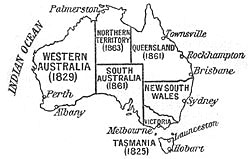
The Australian Colonies
In the 1850s, gold was discovered in Australia, and in 1861, gold was discovered in New Zealand. In 1851, a man by the name of Edward Hargraves discovered gold in Bathurst, a town in New South Wales (southeastern Australia). “Gold fever gripped the nation” as more and more people rushed to NSW to dig for gold, deserting their hometowns, much like what happened in California and Nevada in 1848 and 1849. (cultureandrecreation.gov.au)
In New Zealand during the 1860s, a series of wars broke out among the Maoris and the British, due to the Maoris’ unwillingness to sell their land. Much like the Revolutionary War in American history, there were some Maoris who sided with the British and fought against their own. (history-nz.org) The wars ended in 1972, with thousands of deaths, a majority of which were Maoris. “By 1900, this was a settler society, with Maori pushed out to its fringes.” This is a lot like how the settlers pushed the Native Americans out of their original land and forced them to move to reservations in the nineteenth century. (nzhistory.net.nz)

All in all, I think the early histories of Australia, New Zealand, and the United States are very similar; all were British colonies, all gained their independence, and all had their fair share of difficulties along the way. Although we all have our differences, Australia, New Zealand, and the US have a lot in common if you take a closer look.

Saturday, January 22, 2011

Blog 2-Discussion

1.) I travel because I want to see what else is out there, and maybe to see what else is in me.  When I am traveling, I often find myself without luxuries I am used to having at home, such as being able to just walk up to the fridge and take out string cheese when I want a snack.  Traveling really teaches me how I get around not having these luxuries, and that's why I love to do it.  I discover little things about myself, such as when I am in a hotel, I always shower right before I go to bed so my hair can dry overnight because I don't travel with a blow dryer.  Or that I always drink orange juice at continental breakfast, but never at home.  (I still have no idea why I do this.)  My reasons to travel do line up with Iyer's.  Iyer mentions that when we are on "the road, we often live more simply", and this is precisely what I do, but not just in the obvious ways.  I also tend not to wear makeup or put any products in my hair when I travel (many girls wouldn't give these things up for anything).  Not because I don't bring them, but because I feel that I have much more important things to do.  I relate most to Iyer's references to simplicity because I find myself to be a much more low maintenance person when I'm away from home.

2.) This means that even if you have seen a picture of the Taj Mahal countless times, you never really feel the magic until you actually see it.  It's impossible to capture the sounds and smells and tastes and textures in a picture, so when you go to a magnificent place for the first time, you can see it with a new outlook.  When you think back to that place, you don't think of the pictures you see, you think of the view and the people and the smells and sounds you experienced.  This would apply to me because this is actually how I feel when I go someplace that I have only seen pictures of.  When I think of certain places such as San Francisco, I think of the foggy morning I spent with my family biking across the Golden Gate Bridge, not the opening credits of Full House.  (Full House is what I used to picture before I actually visited San Francisco.  I promise.)  Going to a new place makes me look at it differently.  I take mental pictures and associate completely different words with them than I would have before I visited, which is how my mind processes looking at things in a new light. (When I think of Santa Fe, I think cold and windy, not sunny and warm, as one would expect.  Boy, that was a surprise.)
This is exactly what the Golden Gate Bridge looked like on that morning.  You couldn't even see the top.
 3.) When you travel, you fear just about everything.  What are you going to eat, how will you get over any language barriers, whether you'll like your destination, and I think the list goes on for about sixteen more miles.  However, traveling forces you to overcome these fears, and upon returning, you can cross some things off your list of things you're afraid of.  Fear is what turns a travel into an adventure.  On this trip to Australia and New Zealand, we're going to be faced with things we'll be afraid of, like it or not.  Overcoming them is what will make this trip that much better.  For instance, some people find trying new foods terrifying.  But that's going to happen.  And who knows?  Maybe we'll return with some new favorites!

4.) I do believe that a certain burden rests on each traveler's shoulders and this is precisely it.  As travelers, we go places to learn, and it is our duty to share the knowledge upon returning.  In addition, friends and family kind of expect the traveler to share his or her new knowledge.  What would the point of a carrier pigeon be if no one wanted or needed the information he or she carried?  It would be like going to college and then doing nothing with that sought-after diploma that you worked so hard to earn.

5.) "For if every true love affair can feel like a journey to a foreign country, where you can’t quite speak the language, and you don’t know where you’re going, and you’re pulled ever deeper into the inviting darkness, every trip to a foreign country can be a love affair, where you’re left puzzling over who you are and whom you’ve fallen in love with."  I absolutely love this quote because it describes traveling in a way I have never seen before.  I have never associated travel with falling in love, and this quote showed me how those two parallels can be drawn.  It also absolutely sucked me in.  I was able to picture it in my head, kind of like a movie.  (It sounds weird, but I pictured a bunch of black and white photos of major cities.)  Besides, I think it's beautifully written.
Paris
London

Sunday, January 9, 2011

Blog 1-Once Upon a Time...

Hi, my name is Bridget, and I'm a sophomore at North.  I guess there's not much to say because everyone always says we learn by experiencing things, but I'll try to tell you about myself in a nutshell.  I'm Irish.  Yes, I have been to Ireland.  No, I have never seen a leprechaun, but I'll let you know when I do.  My favorite color is fire engine red, my favorite movie is The Breakfast Club, and my favorite song is Let It Be by The Beatles.  I play soccer and tennis, but mostly soccer.  My favorite soccer team is Chelsea FC, and my favorite tennis player is Rafael Nadal.  I have an older brother who is 20, and I live with both of my parents. My outlook on life is that you only get one, so why not stretch its limits and see how far you can go?  
The Breakfast Club.  Clockwise, from top left: John Bender (the criminal), Andrew Clark (the athlete), Claire Standish (the princess), Brian Johnson (the brain), and Allison Reynolds (the basketcase).

I signed up for this course not only because I really want to go to Australia and New Zealand, but because I also want to gain an understanding and another point of view of how Australians live.  I have no idea as to what they eat for breakfast, or where they go on vacation, or what time they eat dinner, or how they came to live on the island.  And that's really why I'm here; I want to know.  If I'm going to visit, I might as well have some insight into their culture.  Besides, a half of a history credit isn't too bad either.

I hope that traveling abroad will show me just who I am and why I am the way I am.  I hope that looking at another culture and being submerged in it will help me understand the American culture among others.  I'm also hoping to learn just how good I am with rolling with the punches.  At times I can be either very lax and chill, but at other times, I'm wound tighter than a spring and an absolute perfectionist, so I would love to know which one I am the majority of the time.  I think that traveling abroad will reveal just what type of person I am and how I cope with the not-so-awesome situations, as well as how others deal with them too.
The Sydney Opera House!
I have never been to Australia or New Zealand, and I know next to nothing about their culture, including cuisine, daily routines, where they vacation, where they dream of traveling, and what they do on their own time.  I also really like the idea of going to the Great Barrier Reef and seeing the Sydney Opera House as well as other landmarks because these are things you only hear of and see static pictures of.  I personally like to see people and things moving, to be there, to live it, and to observe it.  For instance, when you see pictures of the Eiffel Tower, you only see the view from the top and the tower itself.  You never see the vendors beneath trying to sell you cheap key chains or ice cream cones or postcards.  That is exactly what fascinates me about other places; the people that live there and use these landmarks to their advantage.

I think that learning about a place before you visit can make an experience much more exciting because you actually know about where or what you're visiting.  As you learn about where you're going, it really makes it real and it gets you pumped for the trip.  It's also important to learn the history because you appreciate the experience so much more than if you just know what's written on the plaques because you can be looking at something and just think, hey, we talked about this in class, and I can really see how this is an important feature.  The whole trip is just that much more valuable.