Sunday, March 6, 2011

Blog 4-Creation Examination

1.) Every human culture has a beginning, and it is often characterized by their legends, stories, myths, and their very own creation.  Each culture wants to be different, to have their own ways, to be original in the very literal meaning of the word.  This is why I think each culture, race, or religion wants to have their own way of distinguishing themselves from the other.  Creation myths and stories definitely still have a place in today's society; just look at religion.  Each religion has its own way of explaining the creation and man's origins.
2.) The Australian Aboriginal creation story is mainly about the Sun Mother, who is the giver of light everywhere.  This story shows that the Aboriginals must value mothers a lot because the mother in this story gives the light of the Earth and gives power to everything.  It seems to me that the Australians are more about animals and spirits than people.  The two Maori versions are darker, but are more about family in general.  They both begin with explaining that everything that exists was created from Nothingness.  In one version, Nothingness is known as Te Kore, and in the other, Io is a supreme being that creates the earth out of nothing.  The Maori versions center more on the gods, so I think the Maoris are more about the gods and their families, where Aboriginals are more about animals and roles in the family.
3.) In the Aboriginal story, the Sun Mother goes around giving light and warmth to everything and is in charge of pretty much the entire Earth.  However in the Maori versions, there was originally nothing, and that was what everything was created from.  The Maori versions are more focused on family and conflicts and how they're resolved.  The two Maori versions are very similar, but end differently.  The second version simply ends with the creation of woman, whereas the first goes on to end with the woman becoming the goddess of the night. However, all three discuss the importance of a balance of power, the importance of the sun, and the importance of family.  The differences between Aboriginal and Maori stories probably just stem from the fact that these two cultures are different and originated in different places.  The differences between the Maori stories may stem from different people telling the story differently, or a difference in how they were written down, or maybe someone just forgot a few things and added their own style to the story.
Papa and Rangi
4.) These stories all address the disagreements among family members.  All three stories contain some sort of a conflict within the family whether it be amongst the siblings or with the parents and their children.  Family disagreements are definitely not something that science really addresses, and they're also very universal; every family has its disagreements now and then.  These stories also address envy, especially the first one.  Jealousy is a big problem today within our society, and jealousy creates greed, which branches off into many other smaller problems.  Again, these problems cannot be explained by science, as they are problems of society.
5.) Even though I believe there is a God, I personally believe in evolution because the evidence is overwhelming and I'm also a very strong believer in science.  It shows me how things can change over time, and from that I believe that people can change.  I see the world as something that is constantly changing for the better, and sometimes for the worse, but we are learning.  It helps me accept the ugly (hello, platypus?) and how to deal with it.  To me, evolution makes the most sense because I just can't see how once there was nothing and now there's everything.  It just doesn't come together in my head.

Blog 3-History Time!

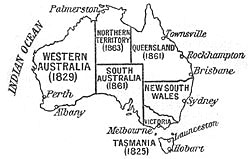
As you may recall, in 1769, Captain James Cook made one of three expeditions to the islands of New Zealand. Other explorers, upon reading Captain Cook’s journals, thought that exploring these fine islands might not be a bad idea, so they followed suit. The following year, Britain thought Australia was up for the taking, so they decided to claim it. In 1788, they settled the first of six colonies. Sound familiar? It should. Think back to 1776: we were just writing our Declaration of Independence, disassociating ourselves from those tea drinkers after they made thirteen colonies out of us. (ourdocuments.gov) The year before Britain settled their first Australian colony, we wrote our Constitution.
The Australian Colonies
In the 1850s, gold was discovered in Australia, and in 1861, gold was discovered in New Zealand. In 1851, a man by the name of Edward Hargraves discovered gold in Bathurst, a town in New South Wales (southeastern Australia). “Gold fever gripped the nation” as more and more people rushed to NSW to dig for gold, deserting their hometowns, much like what happened in California and Nevada in 1848 and 1849. (cultureandrecreation.gov.au)
In New Zealand during the 1860s, a series of wars broke out among the Maoris and the British, due to the Maoris’ unwillingness to sell their land. Much like the Revolutionary War in American history, there were some Maoris who sided with the British and fought against their own. (history-nz.org) The wars ended in 1972, with thousands of deaths, a majority of which were Maoris. “By 1900, this was a settler society, with Maori pushed out to its fringes.” This is a lot like how the settlers pushed the Native Americans out of their original land and forced them to move to reservations in the nineteenth century. (nzhistory.net.nz)

All in all, I think the early histories of Australia, New Zealand, and the United States are very similar; all were British colonies, all gained their independence, and all had their fair share of difficulties along the way. Although we all have our differences, Australia, New Zealand, and the US have a lot in common if you take a closer look.